
Home of the River City and Joint Base San Antonio
Epoxy Flooring in San Antonio, TX
Coatings chosen for long, humid summers, sudden storms and slabs from every decade of the city's growth.
- Free estimates at your property, where we measure and inspect the slab in person
- A moisture test on the concrete ahead of any coating
- Written quotes that list the surface prep and each coat by name
A Floor Plan for South Texas Weather
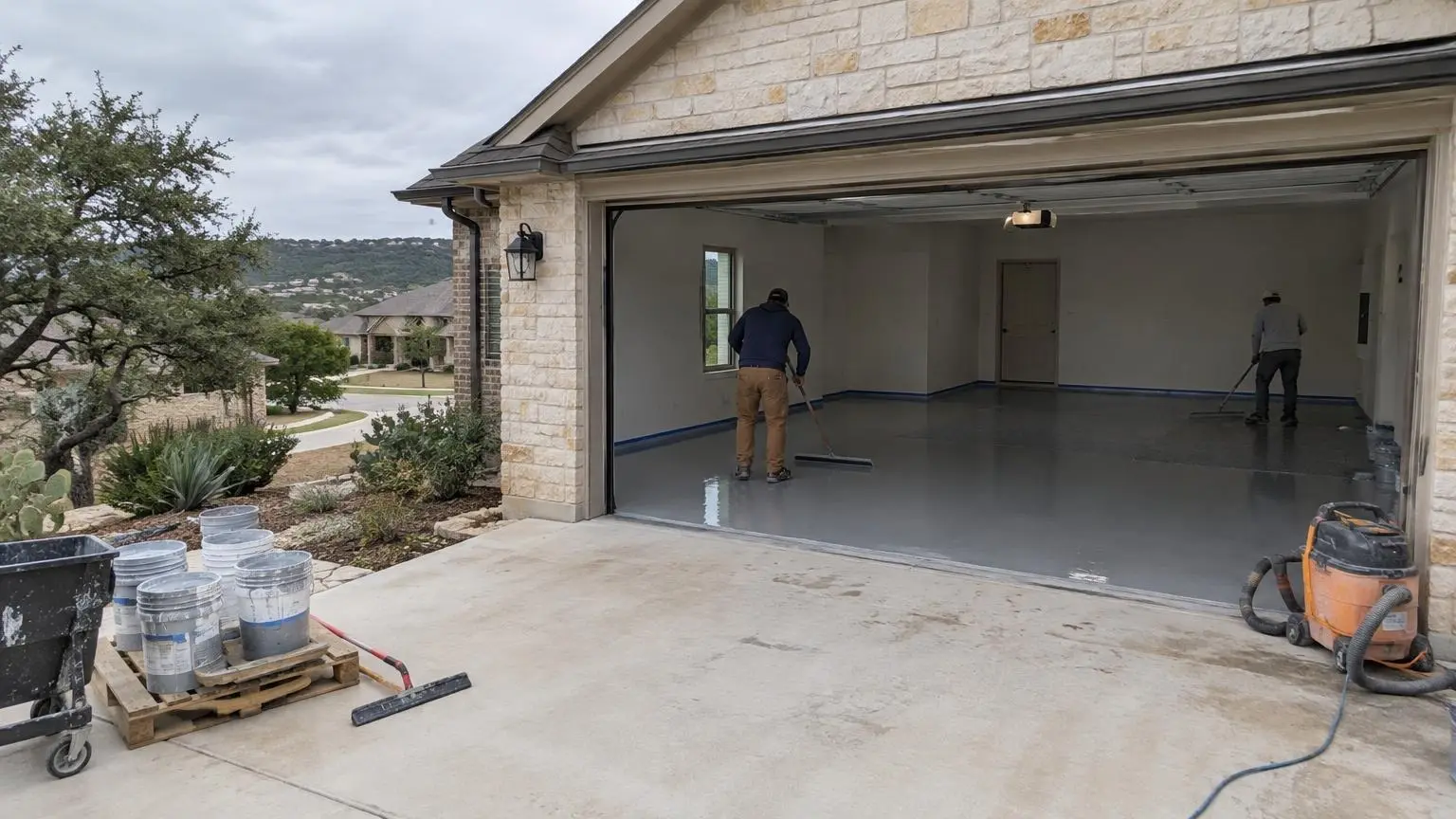
Epoxy flooring in San Antonio faces a double challenge: heat that lingers for months and air that rarely dries out. July and August both average highs near 95 degrees, and average relative humidity across the year sits at 66.9%, peaking in May at 70.5%. A coating that cures well in a dry climate can blush, stay tacky or trap moisture here if the installer ignores the weather. We plan each San Antonio job around the day's temperature and dew point, not just the calendar.
Why the dew point matters on install day
Concrete in a closed garage can sit cooler than the air outside. When warm, wet air meets that cooler slab, a thin film of moisture forms on the surface, and resin applied over it can cloud or lose grip. Nothing gets mixed until we have compared the slab's temperature with the dew point. If the margin is too thin, we adjust the schedule, run fans or pick a product with a wider window. Polyaspartic topcoats cure fast, which helps on muggy mornings, but they also give less working time, so crew size and batch size change with them.
Storm water and the slab
San Antonio and nearby New Braunfels are described as some of the most flood-prone areas in North America. The October 1998 floods across Central Texas caused about $750 million in damage, and the city sits along the Balcones Escarpment, part of what is known as Flash Flood Alley. For a garage floor, that means two practical questions. Does water reach the slab from outside during heavy rain? And does moisture move up through the concrete from below? Each slab gets a moisture reading, and we study door thresholds and drainage before we suggest a system.
Slabs from many decades
The city's housing spans a long building history. The 1980s account for about 16.1% of homes, the 2000s for 15.5% and the 1970s for 13.3%, and the median home was built in 1985. An older slab may carry decades of oil, plus paint or sealer that the grinder must remove. A newer one may be smooth and dense, which also needs grinding so the primer can bite. Either way, the prep is where the money goes, and your quote should spell it out.
Floors that work for a living
Military installations such as Lackland, Randolph, Brooke Army Medical Center and Fort Sam Houston, a Toyota plant on the South Side and the South Texas Medical Center all shape what businesses here need from a floor. Warehouses, shops, clinics and kitchens each call for a different system. We match thickness, texture and chemical resistance to the work done on the floor, and we schedule in phases so a business can keep running.
The rare hard freeze
San Antonio sees roughly a dozen nights below freezing a year, and February 2021 brought 4 to 6 inches of snow. Cold snaps are short, but a garage door left open during one can chill a slab quickly. A well-bonded epoxy or polyaspartic floor handles that fine. The risk is mostly during installation, so we avoid coating on nights when the slab will drop too far before the resin sets.
San Antonio Conditions That Shape a Floor
- Humid most of the year. Average relative humidity is 66.9%, ranging from 63.2% in March to 70.5% in May, according to the city's climate data.
- Long, hot summers. July and August tie as the warmest months with average highs of 95 degrees; the record high is 111 degrees, set on September 5, 2000.
- Flood-prone terrain. The city sits on the Balcones Escarpment in Flash Flood Alley; the October 1998 floods caused about $750 million in damage and 32 deaths.
- A mix of slab ages. ACS figures show a median build year of 1985, with 16.1% of homes from the 1980s and 15.5% from the 2000s (via Point2Homes).
San Antonio Questions
What time of year is easiest for coating a garage in San Antonio?
Spring and fall usually give the widest window, with moderate slab temperatures and lower risk of condensation. Summer installs are common too, though crews tend to begin at first light and keep a close eye on the dew point.
Will a dark epoxy floor get too hot in a San Antonio garage?
Dark colors absorb more heat when sunlight hits them through an open door, and they show dust and tire marks. Lighter flake blends and a UV-stable topcoat stay cooler looking and resist fading.
Can you coat a slab that took on water in a flood?
Often, yes, once it has dried out and tested within range. We take moisture readings, look for damage at cracks and joints, and move to a moisture-tolerant primer when the numbers run high.
How does epoxy flooring cost compare with tile or paint here?
Garage paint is cheaper up front but tends to peel under hot tires. Tile costs more and has grout lines. Your written estimate from us will show the exact price for your slab and system.
Free Estimates in San Antonio, TX
Book a free on-site visit anywhere in San Antonio; the slab is moisture tested before you see a price.
Epoxy Flooring Near San Antonio
- Epoxy Flooring in Alamo Heights, TX
- Epoxy Flooring in Terrell Hills, TX
- Epoxy Flooring in Olmos Park, TX
- Epoxy Flooring in Shavano Park, TX
- Epoxy Flooring in Hollywood Park, TX
- Epoxy Flooring in Helotes, TX
- Epoxy Flooring in Leon Valley, TX
- Epoxy Flooring in Converse, TX
- Epoxy Flooring in Live Oak, TX
- Epoxy Flooring in Universal City, TX
- Epoxy Flooring in Schertz, TX
- Epoxy Flooring in Cibolo, TX
- Epoxy Flooring in Selma, TX
- Epoxy Flooring in Garden Ridge, TX
- Epoxy Flooring in New Braunfels, TX
- Epoxy Flooring in Boerne, TX
- Epoxy Flooring in Fair Oaks Ranch, TX
- Epoxy Flooring in Castle Hills, TX
- Epoxy Flooring in Windcrest, TX
- Epoxy Flooring in Kirby, TX
- Epoxy Flooring in Timberwood Park, TX
- Epoxy Flooring in Bulverde, TX
- Epoxy Flooring in Seguin, TX