
Commercial and industrial floors
Commercial & Shop Epoxy in San Antonio, TX
Floors built for forklifts, chemicals, washdowns and inspections, scheduled around your business.
- Free estimates at your property, where we measure and inspect the slab in person
- A moisture test on the concrete ahead of any coating
- Written quotes that list the surface prep and each coat by name
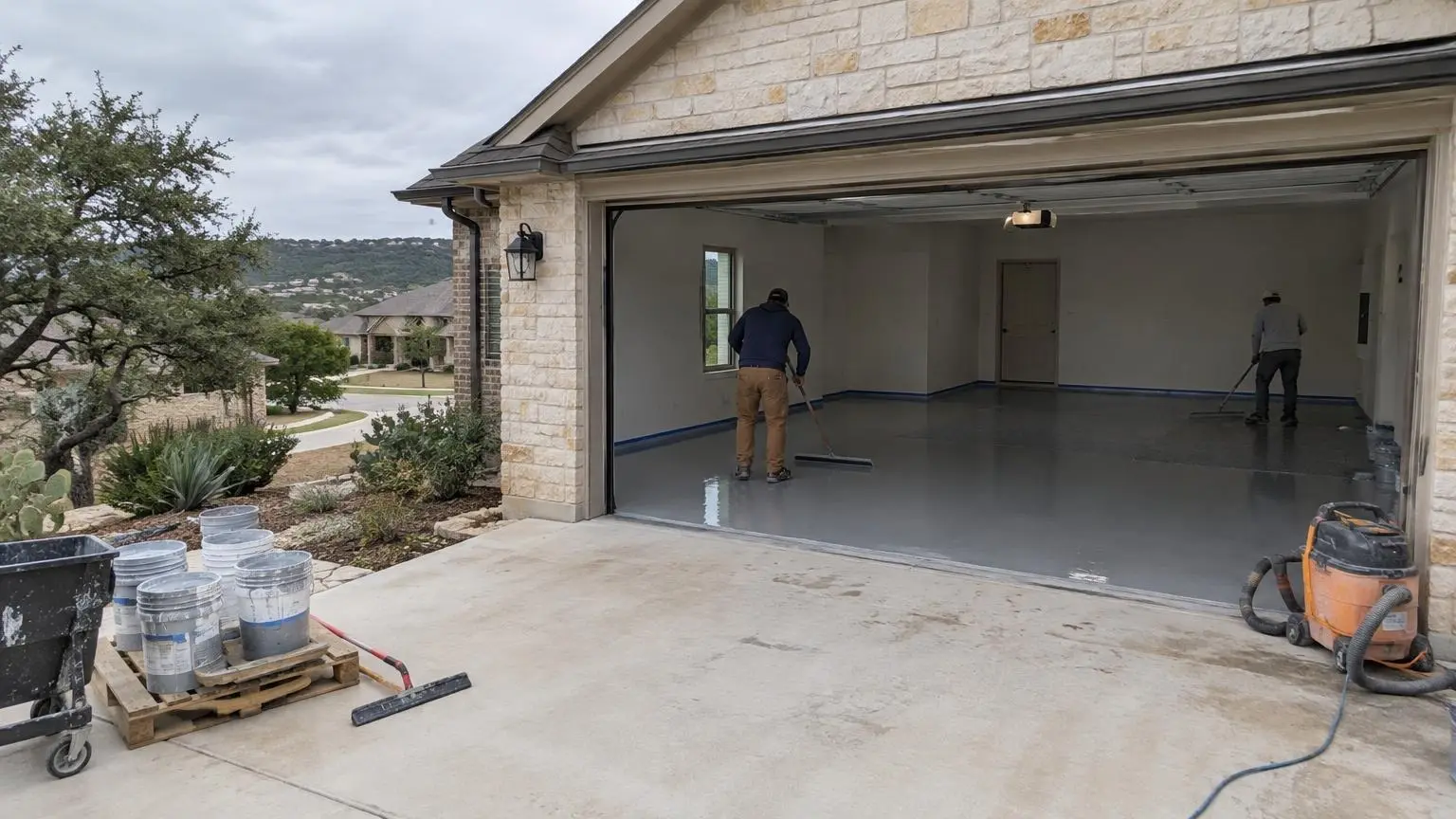
Floors for Places That Work for a Living
Commercial & shop epoxy in San Antonio covers a wide range of floors. Wikipedia describes the city's economy as centered on the military, health care, government and civil service, professional services, oil and gas and tourism, and notes that the city has added a sizable manufacturing sector centered on automobiles, including a Toyota plant on the South Side. Joint Base San Antonio, which joined Fort Sam Houston, Randolph and Lackland in 2010, is described as the largest single Department of Defense installation. All of that means auto shops, warehouses, clinics, commercial kitchens, labs, hangars, retail floors and contractor shops, and each needs a different commercial epoxy flooring system.
Matching the system to the work
A commercial floor gets picked by what happens on it. A distribution floor with forklifts needs a thick, hard coating that resists abrasion and impact. An auto service bay needs resistance to oil, brake fluid, coolant and hot tires. A commercial kitchen needs a textured, seamless floor that holds up to hot water, grease and cleaning chemicals, often with a coved base so the floor turns up the wall. A clinic or lab needs a surface that is easy to disinfect. A retail floor may want a decorative finish. We ask detailed questions about chemicals, loads, traffic and cleaning before recommending any concrete floor coating.
Industrial strength and thickness
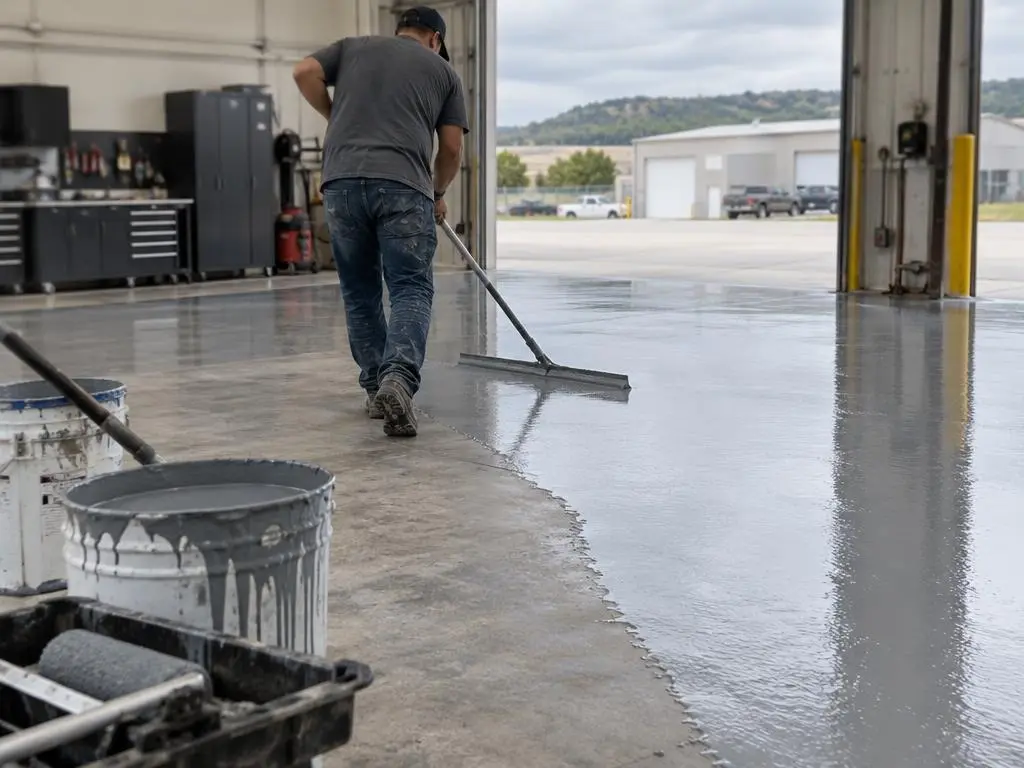
Industrial floors usually call for 100% solids epoxy, thicker builds or urethane cement systems instead of the thinner coatings used in homes. For 100% solids systems in commercial and industrial buildings, HomeAdvisor gives $12 per square foot as the floor of its range. Thickness, broadcast aggregate for traction and a topcoat that resists chemicals all add cost, but they are what let a floor survive pallet jacks and dropped parts. We also look at joints. Control joints and cracks in industrial slabs are where coatings chip first, so we fill and treat them to match the traffic over them.
Keeping the business running
Downtime is often the biggest cost on a commercial job. We can split a floor into zones and coat them in sequence, schedule crews after closing or on a weekend, and choose quick-setting polyaspartic or polyurea where it suits the floor. Bob Vila says a business that goes with polyaspartic might be closed for as little as a day or two. We plan the schedule with you in writing, showing the point at which each zone is ready again for people on foot, then carts, then full loads. Grinding uses vacuum-connected equipment to keep dust down in occupied buildings.
Heat, humidity and big slabs
Large commercial slabs in San Antonio face the same weather as a home garage, at a bigger scale. Warehouses with dock doors open on a humid morning can bring the slab close to the dew point, and summer heat shortens working time for any resin. Wikipedia's climate table shows average summer dew points near 69 degrees, and Flash Flood Alley storms can soak the ground around a building for days. We test moisture in several spots on a large slab, since readings can vary across one floor, and plan the work around temperature.
Shops, barns and home businesses
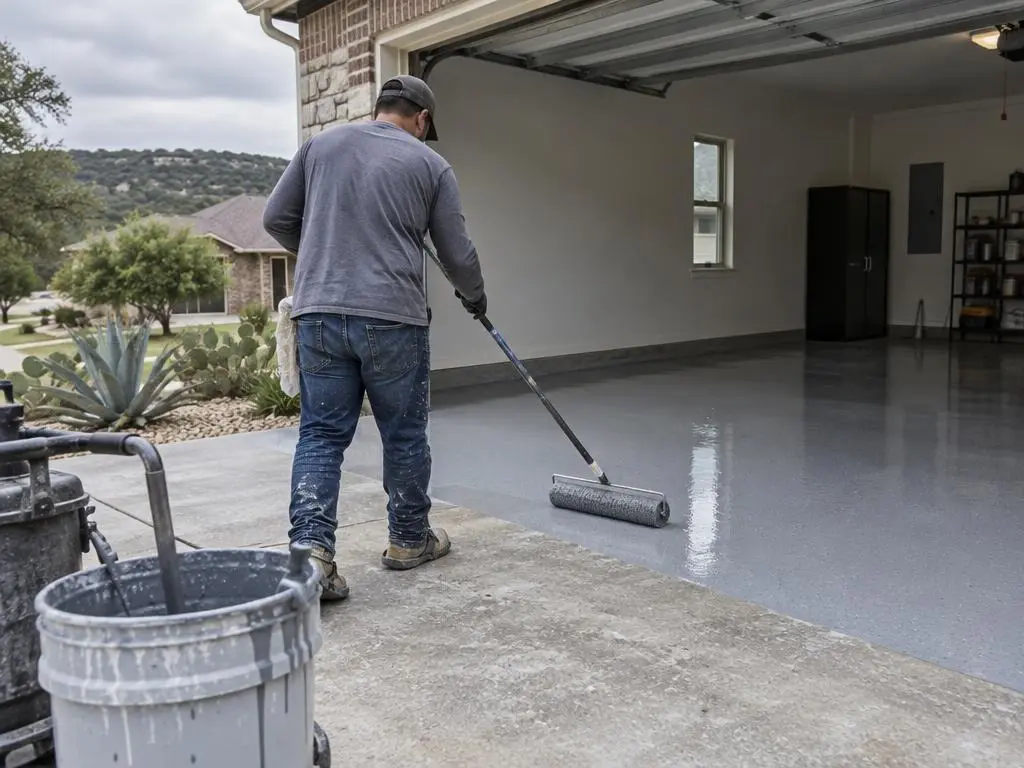
Not every work floor is in an industrial park. Many San Antonio area properties, especially on larger lots to the north and east, have detached shops, barns and work garages for trucks, trailers, tractors and woodworking. These floors take a beating from jacks, welding spatter, dropped tools and fluids. A shop epoxy system with a thick base, flake or quartz broadcast and a topcoat built to shrug off chemicals outlasts paint by a wide margin, and it makes the space far easier to sweep and clean. Lighter colors also brighten a shop with limited windows.
Pricing a commercial floor
Commercial projects are priced by the square foot, the system and the schedule. Industrial 100% solids work begins at $12 per square foot in HomeAdvisor's guide, and it says small jobs often carry a contractor minimum of $500 to $1,000. HomeGuide lists standard installed epoxy at $4 to $10 per square foot for lighter-use floors. We walk the space, test the slab, ask about use and cleaning and write a full scope and schedule. The written estimate is the price.
Cleaning and upkeep on a work floor
A coated commercial floor is only as good as its cleaning plan. We ask what you clean with, how often and whether you use scrubbers, pressure washers or degreasers, then choose a topcoat that holds up to that routine. We also tell you what to avoid, such as certain solvents or stiff wire brushes, and how to spot wear early in high-traffic lanes. A worn lane can often be recoated in a weekend before the coating wears through to concrete.
Safety and appearance
Commercial floors are also about safety. Textured topcoats and broadcast aggregate add grip in wet or greasy areas. Coated walkway lanes and colored zones show staff and visitors where to walk and where equipment runs. A light, reflective floor color can make a warehouse or shop brighter, which helps both safety and the look of the space for customers and inspectors.
Commercial Systems and Services
Common commercial and industrial floor builds we install.
100% solids epoxy
Thick, hard industrial coating for warehouses, plants and heavy-traffic floors.
Auto and service bays
Chemical-resistant systems for oil, brake fluid, coolant and hot tires.
Commercial kitchens
Seamless, textured floors, with coved base available along the wall line.
Quartz and aggregate broadcast
Added grip for wet or greasy areas and ramps.
Line striping and safety zones
Coated lanes, walkways and color zones built into the floor.
Shop and barn floors
Thick flake or quartz systems for detached shops and work garages.
Phased and after-hours work
Zones coated in sequence or outside business hours to limit downtime.
Typical Commercial Floor Coating Costs
| Item | Published range (source) |
|---|---|
| 100% solids system, commercial or industrial use (per sq ft) | $12 and up (HomeAdvisor) |
| Standard installed epoxy, per sq ft | $4 to $10 (HomeGuide epoxy guide) |
| Polyaspartic, per sq ft | $5 to $12 (HomeGuide polyaspartic guide) |
| Contractor minimum for small jobs | $500 to $1,000 (HomeAdvisor) |
| High-grade coating upgrade | Adds 20% to 30% (HomeAdvisor) |
| Patching cracks and chips | $25 to $250 (HomeAdvisor) |
National published ranges. Loads, chemicals, slab condition and scheduling decide the real number. After a site walk and moisture testing, the written estimate and scope we send is the price.
How a Commercial Job Is Planned
1. Site walk
We look at the floor, the traffic, chemicals, loads and cleaning methods.
2. Testing
Moisture readings in several spots and a check of cracks, joints and old coatings.
3. Scope and schedule
A written system, scope, price and zone-by-zone schedule.
4. Prep
Diamond grinding or shot blasting with dust control, then joint and crack repair.
5. Install and return
Coats applied by zone, with times for foot traffic, carts and full loads.
Why Choose Us for Commercial & Shop Epoxy
System chosen by use
We ask about chemicals, loads and cleaning before recommending anything.
Downtime planned
Zones, nights or weekends and fast-cure options where they fit.
Multi-point testing
Large slabs get moisture readings in several places, not one.
Scope in writing
Prep, joints, coats and schedule are all on paper before work starts.
Commercial & Shop Epoxy Questions
What is the best coating for a warehouse floor?
Most warehouses with forklift traffic need a thick 100% solids epoxy or a similar industrial system, with joint repair and often an aggregate for grip. The right build depends on loads, chemicals and cleaning.
Is it possible to coat our floor while we stay open?
Often, yes. We can work in zones, after hours or on weekends, and use fast-cure systems in areas that must reopen quickly.
Do you coat commercial kitchens?
Yes. Kitchens need a textured, seamless floor that handles hot water and cleaners, and we can turn the coating up the wall as a coved base.
What about a detached shop or barn?
We coat home shops, barns and work garages. A thick base with flake or quartz, finished with a topcoat made to resist chemicals, stands up well to jacks, tools and fluids.
Commercial & Shop Epoxy Service Areas
- Epoxy Flooring in San Antonio, TX
- Epoxy Flooring in Alamo Heights, TX
- Epoxy Flooring in Terrell Hills, TX
- Epoxy Flooring in Olmos Park, TX
- Epoxy Flooring in Shavano Park, TX
- Epoxy Flooring in Hollywood Park, TX
- Epoxy Flooring in Helotes, TX
- Epoxy Flooring in Leon Valley, TX
- Epoxy Flooring in Converse, TX
- Epoxy Flooring in Live Oak, TX
- Epoxy Flooring in Universal City, TX
- Epoxy Flooring in Schertz, TX
- Epoxy Flooring in Cibolo, TX
- Epoxy Flooring in Selma, TX
- Epoxy Flooring in Garden Ridge, TX
- Epoxy Flooring in New Braunfels, TX
- Epoxy Flooring in Boerne, TX
- Epoxy Flooring in Fair Oaks Ranch, TX
- Epoxy Flooring in Castle Hills, TX
- Epoxy Flooring in Windcrest, TX
- Epoxy Flooring in Kirby, TX
- Epoxy Flooring in Timberwood Park, TX
- Epoxy Flooring in Bulverde, TX
- Epoxy Flooring in Seguin, TX
Get a Commercial & Shop Epoxy Estimate
Schedule a site walk and get a written scope and price.